
EPFO Wage Ceiling Raised from ₹15,000 to ₹25,000: What Indian Employers Should Do Now
The EPFO wage ceiling has increased from ₹15,000 to ₹25,000 per month with effect from 17 September 2026. The change is legally effective through Notification S.O. 5109(E), not merely a Cabinet announcement. It can bring eligible employees in the ₹15,000–₹25,000 wage band into mandatory EPF, EPS and EDLI coverage, while increasing the contribution base for many existing members.
FinOps India’s view: employers should not treat this as a simple “change 15,000 to 25,000” payroll configuration. The right response is an employee-level review of statutory wages, PF membership, EPS status, CTC structures, contractor records, September 2026 contributions, and employee communication. The objective is to remain compliant without creating avoidable payroll errors or confusion about take-home pay.
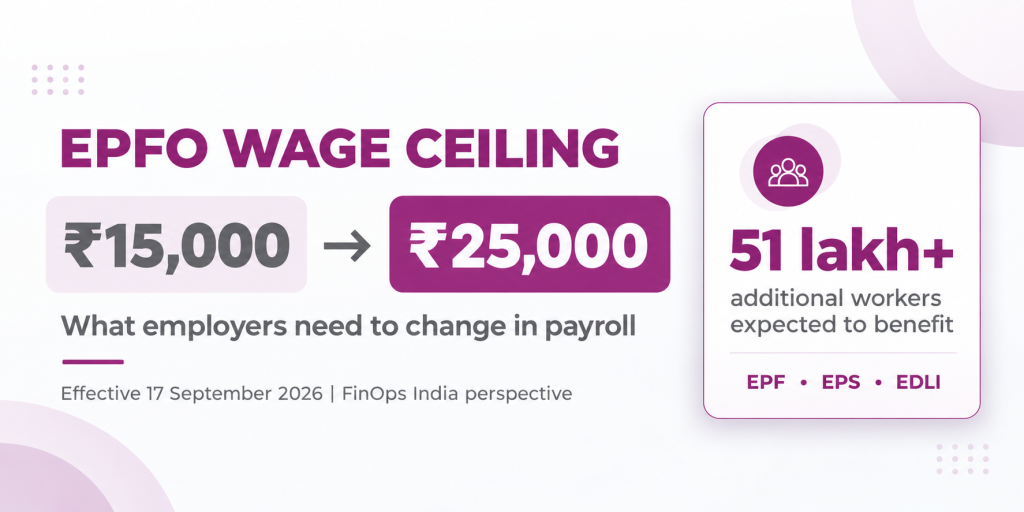
The revised EPFO wage ceiling expands statutory social-security coverage and creates immediate payroll work for employers.
EPFO wage ceiling ₹25,000: the change at a glance
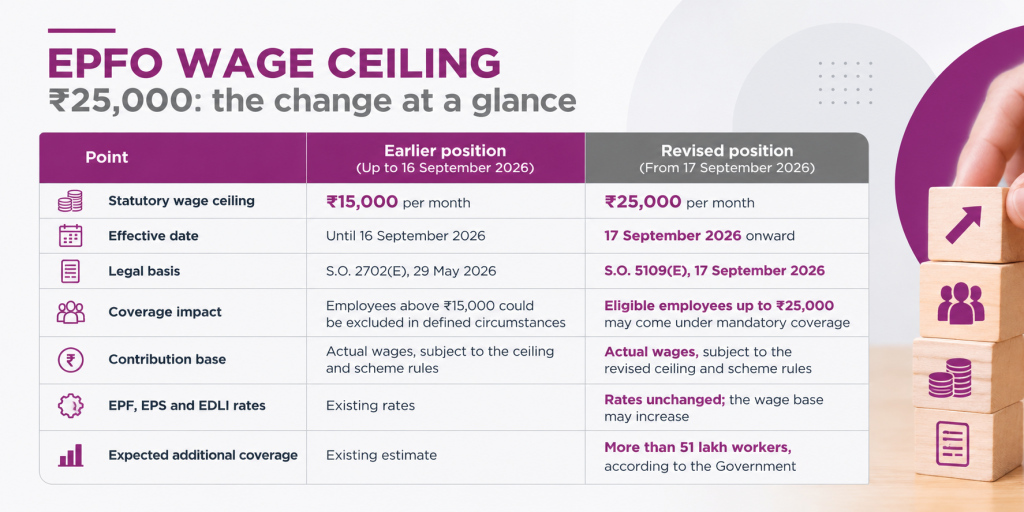
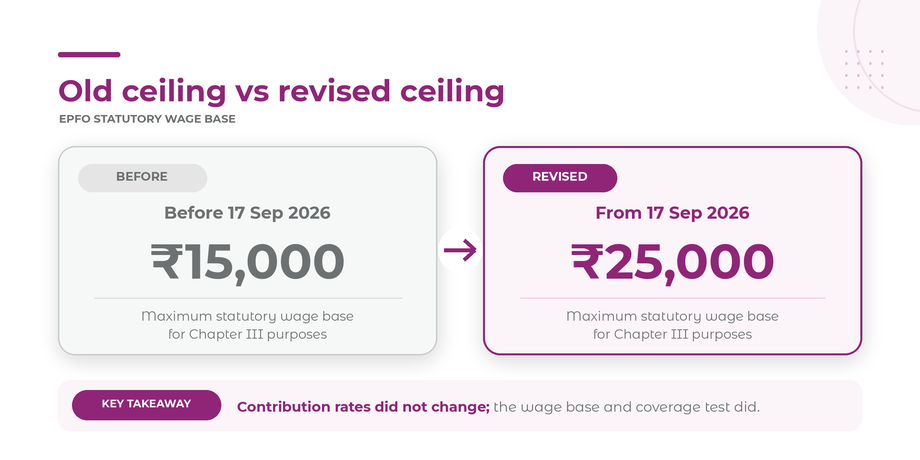
The main change is the statutory wage ceiling. Contribution rates do not automatically change just because the ceiling has increased.
What exactly has changed?
The Ministry of Labour and Employment has notified ₹25,000 per month as the wage ceiling for Chapter III of the Code on Social Security, 2020. The notification supersedes the earlier ₹15,000 notification and applies from the date of publication in the Official Gazette, 17 September 2026. 1
This ceiling is not the same as gross salary, CTC, or take-home pay. Employers must determine the relevant statutory “wages” under the applicable law and scheme rules. A salary package with basic pay, dearness allowance, retaining allowance, and other components cannot be assessed correctly by looking only at the headline gross figure.
The Government estimates that more than 51 lakh additional employees could receive social-security protection through EPF, EPS and EDLI. The policy objective is broader formalisation and stronger retirement protection. For employers, however, the immediate question is more specific: which people in the workforce are affected, and how should their payroll records change?
Who is most likely to be affected?
The first group is employees who were previously treated as excluded because they had never been enrolled in EPF and their relevant wages were above ₹15,000 when they joined. If their applicable wages are now within the ₹25,000 ceiling and they satisfy the other eligibility conditions, they may need to be enrolled from the effective date.
The second group is existing EPF members whose contributions were restricted to the old ₹15,000 ceiling. Their coverage does not begin for the first time, but the contribution base may rise to actual wages up to ₹25,000, subject to the scheme rules and the employee’s status.
The third group includes employees whose wages are above ₹25,000. The increase does not mean that every such employee must suddenly be enrolled or that every contribution must be calculated on full gross salary. Their position depends on their membership history, applicable statutory wage definition, and the relevant EPF provisions.
Employers should also review allowance-heavy salary structures. The statutory definition of wages and applicable add-back rules can affect the PF wage base. A basic-pay field below ₹15,000 is not, by itself, conclusive proof that an employee falls outside the revised framework.
What is the employer cost impact?
The employer’s statutory PF contribution rate has not changed. The potential cost increase comes from two sources: employees newly brought into coverage and existing members whose contribution base rises from ₹15,000 to actual wages up to ₹25,000.
For example, an employee with PF wages of ₹22,000 who was previously excluded could create an employer-side PF contribution of ₹2,640 per month at a 12% rate, before considering other applicable employer-side charges. If the person was already a member but contributions were capped at ₹15,000, the PF component could rise from ₹1,800 to ₹2,640.
The combined statutory cost may include EPF, EPS, EDLI, and administrative charges. The precise amount depends on the establishment, the employee’s status, the applicable rates, and the scheme provisions. Fox Mandal’s commentary notes that the maximum employer-side PF contribution at a 12% rate rises from ₹1,800 to ₹3,000 when the full revised ceiling is used. 3
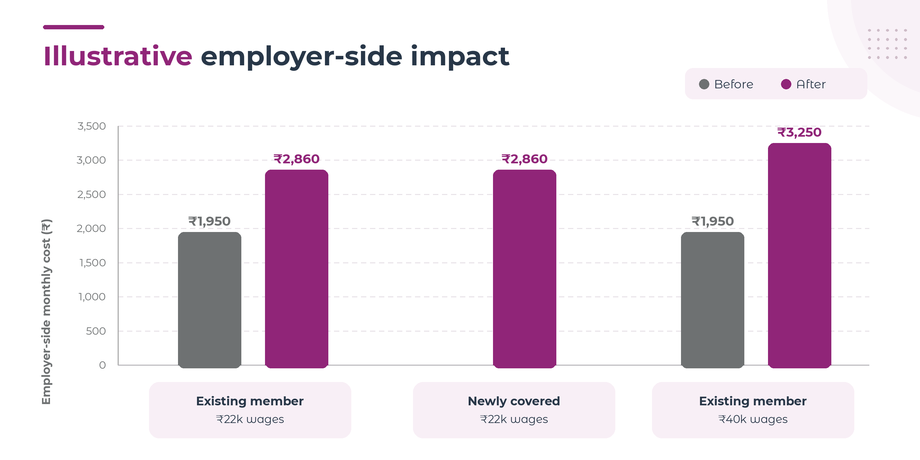
Illustrative examples only. Actual liability depends on statutory wages, membership history, rates, and applicable scheme rules.
From a FinOps perspective, the key budgeting mistake is to multiply ₹1,200 by every employee. The ₹1,200 difference is relevant only in particular cases, such as an existing member whose PF wage base moves from ₹15,000 to ₹25,000 at a 12% rate. A newly covered employee, an employee already contributing on actual wages, and an employee with a different membership or EPS position will have a different result.
What happens to EPS and EDLI?
The EPFO has stated that, where applicable, the maximum EPS contribution is calculated at 8.33% of ₹25,000 instead of 8.33% of ₹15,000. That changes the illustrative monthly maximum from ₹1,250 to approximately ₹2,083, subject to the applicable scheme provisions.
The wider ceiling also affects how payroll teams review the employer contribution split between EPS and EPF. This is particularly important for existing members whose EPS status is not the same as that of a newly enrolled employee. Payroll should not overwrite the EPS flag simply because the ceiling value has changed.
EDLI also requires careful review. The contribution base may be affected by the revised ceiling, but the maximum EDLI benefit is not automatically the same as the mathematical result of multiplying the new wage ceiling by a contribution rate. Employers should follow current EPFO scheme provisions and implementation guidance rather than extrapolating the benefit cap from the ceiling alone. 4
The September 2026 transition: why the first calculation matters
Because the notification took effect on 17 September, September 2026 is a split-period month. EPFO implementation guidance summarised by EY states that the period from 1 to 16 September is subject to the earlier ₹15,000 ceiling, while the period from 17 to 30 September is subject to the revised ₹25,000 ceiling.
Employers should not create two monthly ECRs merely because two ceiling periods apply. The guidance indicates that a single September ECR should be filed, using the applicable calculation for both periods. Payroll teams should retain the working papers behind the calculation so the result can be reconciled to the payroll register and explained during an audit or inspection.
This is also where employee communication becomes important. Some employees may see a smaller deduction in September and a full revised deduction in the following month. If the additional September employee contribution could not be recovered in the September payroll, the EPFO implementation FAQ, as summarised by EY, permits recovery through a subsequent payroll cycle in the specified transition situation.
FinOps India’s recommended employer checklist
- Build an affected-employee population
Extract employees with relevant statutory wages between ₹15,000 and ₹25,000. Separate newly covered employees from existing members whose contributions were capped. Keep employees above ₹25,000 in a separate review group rather than applying a blanket rule.
- Validate statutory wages, not only salary labels
Review basic pay, dearness allowance, retaining allowance, allowance structures, and any applicable add-back rule. Use the statutory wage definition and scheme rules, not only the gross salary or CTC field in the HRMS.
- Recheck EPF and EPS status
Confirm UAN, date of EPF membership, excluded-employee status, EPS eligibility, and the correct joining date for newly covered employees. A ceiling update should not silently change an employee’s historical membership status.
- Update payroll logic and controls
Change the ceiling in the payroll engine, validate the EPF/EPS/EDLI calculations, and test the September split-period logic. Run parallel calculations for a sample of affected employees before closing the payroll.
- Review CTC and employment documentation
The employer contribution is a statutory employer liability. It should not be presented as an employee deduction merely because the organisation includes it in a CTC statement. Employers should review salary letters, CTC annexures, and any net-pay commitments carefully.
- Check contractor payroll
Principal employers should review contractor records and agreements for workers who may fall within the revised coverage range. A compliant internal payroll is not enough if outsourced or contract labour records are incomplete.
- Communicate the take-home impact early
An employee contribution calculated on a higher PF wage can reduce monthly take-home pay. The communication should explain the deduction, the matching employer contribution, the retirement benefit, and the applicable insurance and pension framework in plain language.
What this means for employees
Employees newly covered by EPF may see a lower monthly take-home amount because their own statutory contribution begins. Existing members may also see a higher deduction if the contribution base rises. The employee share is credited to the EPF account, while the employer contribution is allocated according to the applicable EPF and EPS rules.
The change is therefore not simply a pay cut. It trades part of current take-home pay for a larger formal social-security benefit, subject to the governing rules. Employers should explain this accurately without promising a specific future pension or withdrawal amount.
Employees should check their payslip, UAN records, EPF passbook, and the wage basis used for contribution. If the figures do not match the employment terms or statutory basis, the issue should be raised with payroll promptly.
The FinOps India view: compliance needs a controlled process, not a last-minute patch (H2)
The increase to ₹25,000 is positive for formal social-security coverage, but it also exposes weaknesses in manual payroll processes. Companies that depend on hard-coded ceilings, disconnected employee masters, or spreadsheet-only calculations face a higher risk of wrong deductions, missed enrolments, inaccurate CTC reports, and inconsistent contractor treatment.
FinOps recommends treating the change as a controlled payroll project. Finance, HR, payroll, legal, and business operations should agree on the affected population, calculation method, employee communication, accounting treatment, and audit trail. This is especially important for MNCs, GCCs, multi-location employers, and businesses using more than one payroll platform.
For organisations without sufficient internal capacity, FinOps’ payroll outsourcing service can support payroll processing, PF and ESI compliance, statutory reporting, validation, employee payslips, and audit-ready documentation. The goal is not merely to update a number. It is to make the entire payroll process accurate, explainable, and repeatable.
Frequently Asked Questions
Conclusion
The EPFO wage ceiling increase is a major expansion of India’s formal social-security framework. For employers, its real impact depends on the workforce mix, statutory wage structures, existing membership records, and payroll controls. FinOps India’s recommendation is to move quickly, but not mechanically: perform an employee-level assessment, test the revised calculations, document the transition, and communicate with employees before the new deductions appear on their payslips.
This article is for general information and does not constitute legal, tax, or labour-law advice. Employers should verify the latest EPFO instructions and obtain professional advice for employee-specific or establishment-specific issues.